Showing posts with label leftovers. Show all posts

Monday, 29 December 2014

After Christmas

Many apologies to my few followers that I've not been around for a while. I've lacked inspiration, so I've not be able to inspire you. However, the festive season always gets my creative juices running. There's so much food around, and I hate to see things go to waste!

So here's a leftovers pie - but it's a bit posher than usual. First off let me say that this isn't exactly my own idea. I stole it from fellow blogger Lee at Kitchen Connection. I didn't follow it exactly though. Her recipe is for small triangular parcels. I went for something a bit bigger.
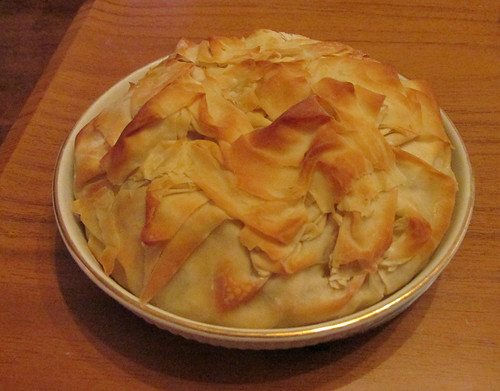
Pie
This is my cheese, onion and potato filo pie. 

Don't waste your time trying to make filo. Even TV chefs say you should buy it ready made.  I bought a pack 'because it's Christmas' but I had no idea what I was going to do with it until I read Lee's post.  I've always avoided filo in the past because I was a bit scared of it, to be honest, but there's no need to be.

This pie took three sheets (and they come in packs of six, so I've frozen the other three). I cut them all into halves.

I began by greasing a pie dish with melted butter. Then I laid three half-sheets into the dish, with melted butter between each layer.

Then I put leftover cooked potatoes and some fried onions in. Between the lumps I dotted bits of cheese. I used what we had left over - some brie, a bit of goat's cheese, and cheddar.  I wish I'd used more cheddar.  I also seasoned it, but it would have benefited from a bit extra pepper, or maybe a little mustard.  It could also probably have benefited from a rasher or two of bacon. 

Once the filling was in I folded over the edges to make a rough side to the pie, then I topped off the hole in the middle by ripping strips off the remaining half-sheets and crumpling them up (like in the photo).  The whole thing was then brushed with more melted butter and popped into the oven at 190C for 20 minutes.

It browned nicely, but the bottom was still slightly soft. I think next time I'll use a metal pie dish, not a ceramic one.

Saturday, 23 March 2013

Emergency rations

We're snowed in here at Auntie Anne Towers so I've done a bit of a review of what's available to make sure we won't starve. It's unlikely to be a long haul - but it's looking like it could be a few days before normal service is resumed.

This is when your store cupboard is vital. I have a few fresh veg - and I never allow myself to run out of spuds or onions. Beyond that it's down to the staples.

Think in headings.

Pasta
I always have dried pasta in store, and there's some fresh pasta in the freezer. So I have spaghetti and I have shapes (currently shells). That means, with some judicious tin opening, I could make:
Spaghetti vongole (I have a tin of clams - but tuna fish would work just as well) Just use some garlic - dried will do to give flavour - and a small onion, to add flavour to the dish. A splash of white wine and a sprinkling of chilli flakes would help. And scatter a few dried herbs over the top - Italian ones for preference: basil, thyme, oregano.
Macaroni cheese. It doesn't have to be tube-shaped pasta in mac and cheese you know. Add some mustard to the sauce for extra punch.
Pasta bake. Just part-boil your shapes and add them to a sauce made from tinned tomatoes with herbs, garlic and onion. Add a few mushrooms if you have them. A tin of sweetcorn nibs wouldn't hurt either.

Rice
Risotto. You can make almost anything into a risotto. Tinned peas, mushrooms, tinned tuna, frozen prawns. As long as you have garlic and onion and some good stock you put by for this kind of occasion, you're made!
Curries. Whatever you have in a tin can be curried. Or this is maybe the way to use up your veg. Or leftovers. If you understand curry spices, go for it. If not, use ready-mix curry powder. Dried coconut, yoghurt, banana flakes, sultanas, all add to the flavour and help vary your dishes.
Chinese. If you've got soy sauce and some sesame oil you can make anything taste Chinese. Specially if you have five spice powder, ginger and garlic.

Leftovers
Seriously - take a good look around your kitchen and see what you have. We had tapas-style dinner yesterday so there were a few bits and pieces in the fridge that I've whizzed up together today into a pan of soup. The stewed peppers have given flavour and the leftover potato salad made it thick. There's some ciabatta that's going a bit dry today, but it'll make great garlic bread. If I make that into cheesy garlic bread it's almost a meal in itself.

Buon appetito!

Thursday, 15 November 2012

Leftovers cooked meat pie


An Auntie Anne Recipe
Looks better after you brown it in the oven

You are all very aware that Auntie Anne likes to save money wherever possible - well here's a tasty way to use up some leftovers and nobody would ever know that you didn't plan it.

If you've followed the advice in other parts of this site you almost certainly have bits of leftover cooked meat in your freezer (pickings from a chicken, the tail-end of a bit of boiling bacon, a couple of chunks of any old roast meats really.) You should also have herbs in your store cupboard and a couple of veggies somewhere in your fridge. And you must have some potatoes somewhere. Maybe you even have leftovers from last night's dinner.

You will need:
Some cooked meat.
A herb that suits it (sage with beef, tarragon with chicken etc.)
Some veg.  Such as mushrooms, tomatoes, frozen peas, tin of sweetcorn, cooked carrot etc.
At least one onion.
A couple of garlic cloves (or dried if you don't have fresh)
Half a pint of milk
A bit of cornflour (a heaped teaspoon or two will do it)
A few potatoes, or some leftover mash.

An Auntie Anne Recipe
Chop your onion roughly and put it into a pan with the milk. Peel and chop the garlic and add that. Simmer it for about 10 minutes until the onion softens. Mix your cornflour with a small amount of cold water and add it to the pan. Bring the whole lot back to the boil, stirring, until teh mixture thickens.  Put it to one side.
An Auntie Anne Recipe

In an oven-proof dish place your chunks of meat and intersperse them with the vegetables. Mushrooms and tomatoes can go in raw; small frozen veg ditto. Hardier veg such as carrots, parsnips, sprouts and such like will need a bit of a boil first to soften them. Sprinkle the whole lot with your chopped herbs. (Dried are fine!)
An Auntie Anne Recipe

Then pour the onion and milk mixture over the top. Set aside.

Peel and boil some potatoes and mash them with a splash of milk. Add nutmeg if you like. It tastes good in spuds. Now spoon the mashed spuds onto the top of the dish and rough up the surface with a fork.

Stick the whole lot into a hot oven for about 15 minutes until it browns on top.  Serve with another veg that doesn't appear inside the pie.


Saturday, 28 April 2012

Smoked fish chowder

Smoked fish chowder


It doesn't have to be smoked fish at all really. Any old fish will do. It's just that this recipe was done with the leftovers from a seafood feast bought at the Port of Lancaster Smokehouse in Glasson Dock, Lancashire.


The stock
The leftovers from a seafood feast: prawn shells, mackerel skins, crab legs, mussel shells, whatever inedible bits you have left.
Lemon slices
Black pepper
Pinch of salt
Water

Put it all in a covered saucepan and bring to the boil. Turn it down to a simmer and keep it going for at least half an hour. Check occasionally to make sure it isn't boiling dry.

Strain the liquid into a jug and keep to one side. Throw away the wreckage.

The chowder
1 small onion (diced)
1 small potato (diced)
a crushed garlic clove
vegetable oil
tomato puree
pinch of dried herbs
small glass of white wine
lemon juice/white wine vinegar
salt and pepper to taste
Yoghurt, cream or soft cheese (at a pinch)
Leftover bits of edible fish can be added if you have any.

In a saucepan, add diced potato, onion and crushed garlic, add vegetable oil and fry gently until the onion starts to look translucent. Add the stock, the wine, a good squeeze of tomato puree and the dried herbs. Bring up to a simmer and taste. Add salt and pepper if necessary and lemon juice/vinegar if you think it needs it. Simmer until the colour deepens. It'll be quite orange at first but the tomato puree starts to darken as it cooks. If in doubt, give it 20 minutes. Add a good dollop of something creamy (the yoghurt, cream or cheese) and stir it round. Add the fishy bits. Bring it back up to temperature and serve immediately.

Monday, 26 September 2011

Cawl - it's Welsh for soup

Yummy soup
Auntie Anne has been to Wales and tasted some very yummy soup called lobscows, but it's also sometimes known as cawl.  (pronounced 'cowl')
A nice bit of brisket
Basically it's a thickened vegetable stock with pieces of meat, usually lamb or beef. You can either start with a piece of meat, such as neck of lamb, or a bit of brisket, and boil it with vegetables to make a stock; or you can make a basic veg soup and add bits of meat to it afterwards. 
Cut out the fatty bits from the meat
It's a great way to use up leftover meat and to make sure you don't waste tail-ends of vegetables in your cupboard.

Monday, 18 April 2011

A week by the sea

Auntie Anne has recently returned from a self catering holiday and it seems like a good idea to let you know what was packed for the trip - and why.  We always take a hamper with us so that we don't have to
worry too much about finding something to eat in an area we haven't got to know yet.
The trip was for a week at the seaside and we checked before we went that there would be a good supply of seafood. Sorry to anyone who doesn't like ocean fodder - this will be a distinctly fishy post!

The supplies box contained:
tin of tomatoes
bottle of easy drinking red wine
bottle of dry white wine
small bottle of olive oil
small bottle of cooking oil
small bottle of white wine vinegar
salt
pepper
dried mixed herbs
curry powder
dried chilli flakes
'longlife' orange juice  (aka UHT)
pack of dried spaghetti (or other pasta shapes if you like)
jar of cockles
tin of olives with garlic
butter
teabags
coffee
sugar
'longlife' milk
jar of marmalade
jar of home made chutney

We also checked what was left in the house that wouldn't last the week. So there was some fresh food in
the box too. We took an onion and a couple of tomatoes and the remains of a head of garlic with us.
There was also a carrot or two and a large courgette.

On the journey we found a grocer's and bought a bunch of flat leaved parsley, a large lemon, some
cucumber, button mushrooms, loaf of bread and some fresh fruit.

First night we were there we hadn't found the local pub yet (and it didn't serve food when we DID find
it) so we made spaghetti vongole.   You can buy proper vongole with their shells still on if you like but you don't have to.  In a smallish pan put some finely chopped onion and a bit of cooking oil, a crushed garlic clove or two and a pinch of dried chilli flakes. Sweat the onion until it starts to turn transparent and throw in a couple of chopped tomatoes. stir it round a bit and add a good glug of white wine. Drain and rinse the cockles then chuck them into the mix.

Meanwhile boil some pasta. When it's done, pour it in the pan with the rest of the mix and stir it round a couple of times. Turn into a couple of large, warm bowls and sprinkle it with chopped parsley,

The following morning, breakfast consisted of a fresh fruit platter with coffee and toast and marmalade.

That day we visited the local fish market and came back with big raw prawns, small smoked prawns, a couple of scallops, roll mops, potted shrimps and a crab. So dinner was easy. Seafood selection. Fry the big prawns in butter and garlic. Clean and slice the scallops crosswise to give you flat disks of meat. (The fishmonger will clean them for you if you don't know how.)  Fry with sliced mushrooms and some garlic.
Smoked prawns in a dish. Crab on a plate. Roll mops on a plate. Potted shrimps warmed up and served in a small heatproof dish. Chunks of bread, butter, tomato salad, cucumber salad. Lemon wedges. Help yourselves.

Leftover crab
There was some crab left. So I bought a small pot of cream and another bottle of white wine. Chop half an onion and boil it in a good slug of white wine to remove the alcohol and reduce to about half the volume. Add a good squeeze of lemon juice and a pinch of curry powder then lower the heat. Stir in the crabmeat - don't let it boil now. Finish it with some cream and a sprinkling of parsley.  Chunks of bread and butter. Yummy!

The carrots ended up being grated and turned into a salad to accompany some local cheeses. The courgette was sliced thinly, steamed for a few minutes, plunged into cold water, drained, then dressed with a vinaigrette made from olive oil, white wine vinegar and a pinch of dried herbs, salt and pepper.

Saturday, 26 February 2011

Store cupboard 2: Easy meals

This time it's mostly tinned stuff and packets

My last post on the store cupboard turned into a bit of a diatribe about herbs and spices and they are all very well but you can't rustle up a quick meal out of nothing but herbs. So I thought this one might be a bit more substantial.

The idea of a storecupboard (well MY idea of a storecupboard) is that it should help you to create good food when you need to. Everyone has those days when they don't fancy what they planned to eat, or they didn't get to the shops or someone turns up unexpectedly and needs to be fed.

That's when the storecupboard comes into play. Some of the things I keep in my cupboard are:

Dried spaghetti and pasta shapes
As long as you've got these, some decent olive oil or butter and your herb selection you can always eat.  Pasta is simple and you can throw almost anything on top of it to make it fancy.  At the least you can boil it, sprinkle olive oil over it and give it a good grinding of black pepper. Anything beyond that is a bonus. Got dried oregano and basil? Chuck them in too. Tail end of some parmesan cheese in the fridge? Grate that over it as well. (And never EVER use that nasty ready-grated stuff in the tubs. It smells of vomit and adds nothing to a meal except unpleasantness.)

Also included in this section are dried noodles. Medium egg noodles are always good and are perfect for under a stir fry of leftover veg.

Rice
Basmati is good if you like curries and it's also a good stand-by for most rice dishes. Risotto rice is handy because you can turn practically anything into a risotto. Tin of peas. Browned onion. Mixed leftover veg. Chicken bits. Fresh tomatoes.
Otherwise just plain old long grain will do. 

Tinned tomatoes
Now you're talking. At their simplest you can chuck them onto a couple of slices of toast and give them a good slosh of brown sauce or worcester sauce. But if you've got them and pasta you're made. Simmer a tin of toms with a few Italian herbs and flavours (basil, oregano, few chilli flakes, garlic salt, black pepper) and, if you have them, any of the following: some sliced mushrooms, chopped cooked veg, leftover cooked meat such as ham, olives, anchovies or other fish, handful of prawns, fruit at a pinch, pineapple might work. Give it about 10 minutes or so on a low heat and if the tomatoes are staying too whole give them a bash with a wooden spoon.
Chuck it over cooked pasta. Yummy.

They also brighten up lots of mince-based dishes like cottage pie, chilli, lasagne, bolognese, moussaka etc. It's a great way to hide veg in meals if you have reluctant eaters too.

Baked beans
They're a staple. On toast with a little cheese grilled over the top. Over a baked potato. Used in chilli in place of red kidney beans. Added to mince to bulk it out and make it a little healthier.

Olives
Tinned olives can be added to pizza or baked into bread or just served on their own as a nibble if people turn up unexpectedly.

Other tinned veg
Whatever you like really. Some pulses are handy - chick peas, borlotti. You can use them to bulk out other things or as the base for a curry. They take ages to cook from dried so a tin or two is much easier.
Sweetcorn: Tinned sweetcorn is wonderful stuff and unlike a lot of veg it doesn't lose its flavour. Goes into salads, fritata (like an omelette), served on the side of practically any 'meat and two veg' kind of meal, mixed with leftover chicken bits and some mayo for a sandwich filling.
Something fancy is always handy too. I keep artichoke hearts and palm hearts. They make wonderful starters with a bit of virgin olive oil and a hunk of bread. They also go well on pizzas and the Italians also put artichokes in ham sandwiches.

Tinned fish
A tin of tuna, mackerel in some sort of sauce, smoked oysters or mussels, white crab meat, prawns.  Open the tins. Put the contents into a load of small dishes and you have tapas almost straight away. Jug of wine, loaf of bread, tin of olives, bowl of mayo. You're made.

Tinned meat
I don't care what anyone says you can't beat a Spam fritter. But a tin of corned beef is always handy too. Mash it up with some leftover spuds and a bit of fried onion, fry it gently until the mixture browns a bit and you've got corned beef hash.


Extra bits
A couple of pints of "plastic" milk

You know the sort I mean. The stuff in boxes. It lasts for ages and you've got the making of custard (as long as you have custard powder in the cupboard too. I always have). In fact here is a recipe for quick steamed sponge pudding to go with it.

Flour
The base for lots of things - not least soda bread, which can be made in about 40 minutes and is so easy you wouldn't believe! But you can also rustle up pancakes as long as you've got an egg and some milk, or buns, or all sorts of stuff. And it's good for thickening soups and sauces.  If you can only run to one bag make it self raising.

Baking powder
You can't make scones without it. Or soda bread. Or quick steamed jam sponge. It's cheap and handy.

Dried yeast
Be brave. Follow the instructions on the back (there's almost always bread instructions on the back of yeast packets) and make some pizza bases. You'll love yourself for it.

Sugar
Well it goes without saying really doesn't it? And besides - we covered it in storecupboard 1.

Good extra virgin olive oil
If you've been paying attention you'll have noticed olive oil mentioned a couple of times already. There is virtually nothing you can eat that won't be enhanced by a drizzle of good olive oil over the top. (OK - maybe not chocolate cake, but you know what I mean)

Mayo
Buy in a medium sized jar and keep it in your fridge. Goes really nicely under cheese on toast. Great for sandwiches. Wonderful with a tinned veg as a starter. Egg mayo - retro but yummy. (Boil an egg. Peel it. Slather mayo over it. Sprinkle lightly with cayenne pepper. Serve with brown bread.) Mixed half and half with yoghurt as a cold sauce base.  Add more or less anything you like. Finely chopped onion, curry powder, anchovies, use your imagination.

Sunday, 6 February 2011

Weekend soup

Yesterday morning we went shopping and when we came back from the supermarket we put everything away, as usual. Of course, as always happens, we had to move out the old bits to make way for fresh food.

As usual I turned the leftovers into soup for lunch. It's quick, easy and, if you were planning on throwing the old food out, free!

You can make weekend soup out of any old raw and cooked vegetables but this one consisted of:

Half a head of chinese leaf (it was Chinese New Year during the week and it didn't fit in the stir fry)
The tail end of a swede
An onion

I chopped it all up then threw it into a saucepan with a tablespoon of oil and a couple of cloves of garlic. (Start with raw vegetables only. If you're including cooked ones they go in later.)

First thing to do is sweat it all down until the veg starts to wilt and the onions start to go translucent.
 
 When you've done it right it will look sort of like this: (That dark green stuff is lemon thyme that I happened to have around.)


Then you need to add some thickening.  If your leftover vegetables included potatoes you won't need to do this bit because the starch in the spuds will do it for you. If not, add some flour and then cook it for a couple of minutes longer, stirring it all the time so it doesn't stick to the bottom of the pan.

Once it starts to look thick and sticky you need to add liquid. You can add either water or stock. Add the cooked veg at this stage if you're using them. Add enough liquid to cover the veg. Bring the whole thing to the boil and then turn down the heat to a simmer. Let it cook for about 10 to 15 minutes then taste it. If it's short on flavour add something to make it tastier.  This one was a bit thin so I added a sprinkling of Chinese five spice powder and a good splash of soy sauce. (But you can add chilli, curry powder, herbs, Worcester sauce, leftover meat, tomato puree, celery salt, anything you like.)

Once you're happy you can blast it through a blender. You might find you need to cool it down before you do, then heat it up again before you eat it. Pour it into bowls and if you want to be really swank you can swirl in some cream or yoghurt and sprinkle it with a few fresh herbs (like in the top picture).

You see - there IS such a thing as a free lunch!

Monday, 4 October 2010

Seafood Feast the Auntie Anne way

One thing we love in our house is seafood. One thing we don't like is having to pay a small fortune for seafood platters in a restaurant.
Seafood is easy to prepare - especially if you have a friendly fishmonger!


This weekend we had a bit of a banquet. We went out and bought:
  • Half a dozen small scallops
  • About half a pound of mussels
  • A bag of shell-on prawns
  • 4 raw crevettes
  • A nice, plump,dressed crab
  • Some good crusty bread
  • Some button mushrooms
  • A small pot of single cream
  • A small bottle of cider
  • A large bottle of white wine
  • Parsley
  • Lemons

We already have in the house:

  • Freshly ground black pepper
  • Onions
  • Butter
  • Olive Oil
  • Garlic
  • Mayonnaise
Begin by placing the dressed crab on a plate and surrounding it with a few lemon wedges.
Give it a bit of fresh black pepper if that's your taste.

Put the prawns into a large bowl.

Wash the mussels, scrape off any barnacles and remove the "beards". That's the hairy bit sticking out from betweeen the shells. Just pull and they'll detach very easily. Discard any mussels that are open at this stage. (Slightly open is OK but fully open isn't.) If you want more help with preparing the mussels see here.

Find a big pan with a lid,
a small saucepan without a lid
a small frying pan.

Chop up a small onion very finely and place it with two sliced cloves of garlic, a good glug of cider and some chopped parsley into the pan with a lid and put it on a low-to-medium heat.

Slice your scallops into 1/2cm thick rounds. Include the orange corals. Put them in the small saucepan with some crushed garlic, sliced mushrooms and a glug of white wine. Don't turn the heat on yet!

Put heat under the small frying pan and add a crushed garlic clove and some olive oil. Now add the crevettes, then listen for them beginning to sizzle.

Put heat under the scallops and get the white wine simmering.

Sling your cleaned mussels into the lidded pan and put the lid back on.

Turn over your sizzling crevettes to cook the other side.

Take your scallops off the heat and let them cool slightly.

Pick up the lidded pan and give it a good shake. Lift the lid. The mussels should be nicely open by now. Pour the whole lot into a big bowl.

Your crevettes should now be nicely pink. Tip them onto a plate. (If they're still a bit blue give them a minute longer while you finish off the scallops.)

Add a generous helping of single cream to the scallops and tip the mixture into a bowl.
Serve all of it with good bread and butter. Black pepper to taste. Bowl of mayonnaise to dip the prawns in.
Don't forget plenty of napkins, a big empty bowl for the wreckage and some REALLY nice, dry white wine. Chilled mineral water helps too.

What can I do with the leftovers?
When you're done you'll probably find there's plenty of mussel juice left and quite a bit of the cream sauce from the scallops. Do not throw them away! Mix together and refrigerate then serve as soup the following day.
Leftover prawns will make sandwiches, prawn cocktail or even go into a fish pie if you have any "fishy" fish available. Or mix them with scrambled egg for breakfast.
Leftover mussels can be frozen and kept for fish pie. (They've been cooked so it's OK.)
Leftover crab can be turned into crab cakes. Just mix it with bread crumbs and any seasoning you like. Thai sauce and coriander; Worcester sauce; mustard; lemon juice and thyme; curry powder; whatever you like. Add a bit of mayonnaise or some olive oil if the mixture is a little dry.  Shape into rounds, flour lightly and then shallow fry in a little groundnut oil.

Friday, 1 October 2010

How to make the most of a chicken

TV seems to be full of advice at the moment on how to avoid wasting food but there never seems to be a FULL story about anything. The other night I saw something about using up leftover chicken. But if you follow the Auntie Anne way you won't have any leftovers in the first place - because you'll have a plan for everything you've cooked - including the bones!

How to make the most of a chicken

Let's start with a little discussion on the type of chicken you buy. Do you think you save money by getting a cheap, battery-bred one? Well you don't. Quite apart from how cruel battery pens are to chickens, they create tasteless, spongy meat. So BUY FREE RANGE! You WILL be able to tell the difference and you will get more out of it in the long run.

So let's start cooking....

First roast your chicken. You might think you know how to do that but - a little care at this stage will pay dividends later. Unwrap the bird and take off any string or bands that are holding it trussed up. Pull on its legs and wings a bit to spread it out. That way the heat can get round it and it'll cook more evenly.

Make sure you roast your bird on a trivet. (That's a metal rack that holds the meat away from the pan bottom.) Place it on the trivet and have a look at the body cavity at the parson's noe end. Just inside the skin flaps you'll find pads of fat. Pull these out and place them on the top of the bird. (Actually it's lying on its back so the "top" is really the bottom - but you know what I mean) The fat will melt during cooking and baste the meat automatically.

Now - for a bit of added flavour, place any or all of the following into the body cavity through the hole where you found the fat: garlic cloves, a whole lemon that's been stabbed with a fork a few times, some fresh herbs, some onion wedges. Put your chicken into a pre-heated oven at about 190 - 200 C. Roast it till it's done. It'll look golden brown and will smell gorgeous. If you are in any doubt, stab it on the inside of its thigh to make sure the juices run clear. If there's any blood, put the bird back in the oven for 10 minutes then try again.

Once it's done, take it out of the oven and let it cool for a while on the trivet. Don't let it go cold or it'll be VERY difficult to portion out.

Dividing it up

You will need:
Your cooked chicken
A large pan that has a lid
A small bowl (cereal bowl or that kind of size)
A larger bowl or plate
A small, sharp knife

Cut the skin along the breast bone. Cut the skin around each of the thighs. Continue the cuts right around the leg and on towards the parson's nose.

Use the back of the knife to ease one of the breasts away from the breastbone and the ribs. Keep easing it until you reach the wishbone. If you cut carefully around the wishbone you should be able to pull it out whole. If there's any meat still attached, remove it and put the meat into the small bowl. Make your wish with the bone - then put it into the pan.  Ease both of the breasts away from the carcass and put them onto the larger bowl/plate, keeping the skin in place.

Take hold of one of the drumsticks and bend the "extra" bit of the leg backwards until it breaks away from the main bird. Put the spare piece in the pan. Repeat with the other leg. Now - take hold of the thigh in one hand and the main carcass in the other hand and twist the leg backwards. It will come away in one piece, breaking away at the hip joint. Repeat on the other side. Put the leg portions on the plate with the breasts.

Now pull off the wings and take as much meat as possible off them. Put the meat into the small bowl and all the bones, skin and sinewy bits into the pan.
Strip any obvious bits of meat off the top of the carcass and add them to the small bowl.

By now your chicken is looking pretty badly battered!

Turn it over to find some of the best bits of meat on a chicken. Strip off the skin and add it to the pan. Identify two long bones that are the equivalent of shoulder blades. Underneath those two bones are pieces of juicy meat. Strip off the meat and add it to the small bowl. Put the bones in the pan. At the end of those two bones you'll find two small, round bits of meat (sort of like chicken nuggets) that are called the oysters. Remove them and add them to the small bowl.

You will also find meat along each side of the chicken's backbone at the neck end and by the parson's nose. Add all of that to the small bowl, which by now should have a reasonable amount of chicken in it.

Chicken stock (you might need to read the bit before this as well)
Take a last look over the carcass and make sure you haven't missed any obvious bits of meat. If you're happy with your gathering, put the rest of the carcass, including any of the additions like garlic, onion, lemon etc from the inside, into the pan.

Now boil a kettle. Pour some boiling water into the roasting pan and stir round to pick up the cooking juices from the bottom. Add the water and juices to the pan with the bones. Add as many as posible of the following to the bones pan: chopped onion, garlic, whole black peppercorns, herbs, a chopped carrot, a chopped stick of celery, slosh of white wine. Top up with water and put the lid on. Bring it to the boil then turn down to a simmer. Leave it simmering, with teh lid on, for about an hour. Keep an eye on it to make sure it isn't drying up. Add water if you think it needs it. Drain the stock into a large jug and throw out the boiled bones.

Now what are you going to do with the bits?

Breast portions.
Treat these exactly like you would roast chicken.
  1. Cold with mayonnaise and a salad.
  2. Roast some vegetables by cutting a selection of the following into large chunks: carrots, onions, mushrooms, garlic cloves, tomatoes (score the tops), parsnips, swede, par-boiled potatoes, cauliflower florets, turnips, anything you like. Put them in a roasting tim and sprinkle with cooking oil. Add salt and pepper and put in a few fresh herbs. Roast at about 200C for 45-50 minutes. Put the chicken breasts on top (with the skin on) for the last 10 minutes to warm them through.
  3. Serve with pasta and a cream sauce.
  4. Slice thickly and make a yummy sandwich.

Leg portions.
You can use these in similar ways to the beast portions but I like them barbecued. Make a sauce by mixing some or all of the following: mustard, tomato puree, ground garlic, honey or brown sugar, brown sauce or Worcester sauce, white wine vinegar, olive oil. Smear it over the chicken and bake the portions for about 25 mins at 200 C until they're thoroughly warmed. Serve with chips and a vegetable.

The bits.
The world's your oyster with these.
  1. Make sandwiches.
  2. Mix with cooked bacon and button mushrooms, Cover in a white sauce and add a pastry lid - instant chicken and ham pie.
  3. Add to stir fried vegetables and serve over noodles.
  4. Cook some long grain rice. Fry an onion and garlic and add the cooked rice, chicken pieces and leftover cooked vegetables to make a risotto.  (If you add seafood it's a paella)
  5. Mix with mayo, curry powder, chopped spring onions (scallions) and a spoon of mango chutney to make coronation chicken. Serve in sandwiches or over baked potatoes.
  6. Chop finely and mix into cooked rice with herbs. Bind with a beaten egg and shallow-fry spoonfuls of the mixture as rissoles. Serve with salad.